


It feels like we’re stuck in an endless debate about what AI will mean for jobs and the economy. Caught in the middle of this debate are actual workers trying to figure out what this means for their livelihoods.
So this week on Your Undivided Attention, rather than continuing to referee this debate, we follow the incentives and show you where they’re actually taking us in the very near future.
Our returning guest, Molly Kinder, recently left her position as a senior fellow at the Brookings Institution to become the founding CEO of a new organization dedicated to addressing AI’s impact on jobs. Her Substack, Kinder Futures: Dispatches on AI, Work & What Comes Next, features some of the clearest-eyed analysis of AI’s impact on the economy.
Tristan Harris: Hey, everyone, it’s Tristan Harris and welcome to Your Undivided Attention. It often feels like we’re stuck in some kind of endless debate about what AI is going to mean for jobs and the economy. Now, no one knows the future, but we know that automation from AI is coming and many fear that it will result in mass unemployment. But if you believe the AI CEOs, they’ll say, “Well, we’ll just solve the unemployment problem. We’ll just have mass redistribution of the economic gains that come from that automation with things like universal basic income or UBI.”
Elon Musk: We probably, none of us will have a job, but in that benign scenario, there will be universal high income. Not universal basic income, universal high income. There will be no shortage of goods or services.
Sam Altman: I wonder if there’s better things to do than the traditional conceptualization of UBI. I wonder if the future looks something more like universal basic compute than universal basic income and everybody gets a slice of GPT-7’s compute.
Tristan Harris: On the other hand, you hear from some techno optimist that there’s nothing to see here. AI is actually creating more jobs than it destroys. Here’s David Friedberg from the All-In Podcast from June.
David Friedberg: There is no job loss with AI. I will say it again, and I’ve said it a thousand times, and I will say it again and again and again. The idea that AI is going to destroy jobs is a Luddite idea that is being disproven every single day. And I see it on the ground. It is only a matter of time before people wake up to this and they realize that this narrative that they’ve all been sold is a crock of (beep).
Tristan Harris: But if you tune to other parts of the debate, you see the Financial Times reporting there’s already been a 40% decrease of US job listings for people who’ve just graduated. And when these facts get traded back and forth, no one can know what’s actually true and then nothing actually happens. And caught in the middle of this debate are actual workers bouncing between the two, just trying to figure out what does this mean for me and my family right now? Should my kid actually go to college? Will my job be safe? And as long as that debate stays alive, nobody plans or takes action for what’s coming.
And so today on the show, we want to follow the incentives and show you where they’re actually taking us in the very near future. Our returning guest, Molly Kinder, recently left her position as senior fellow of the Brookings Institution to be the founding CEO of a new organization dedicated to responding to AI’s impact on jobs.
And I will say that her Substack has some of the most clear-eyed analysis about the impact of AI on our economy that I have ever seen. And what I appreciated so much about this conversation is the systems level thinking that Molly is demonstrating. Where specifically will AI hit concentrated parts of our economy? What are the feedback loops and second and third order consequences of those effects? I hope this conversation resolves the debate around these questions so we can actually finally take action before these problems hit.
So Molly, thank you so much for coming on Your Undivided Attention.
Molly Kinder: Thank you so much for having me, Tristan.
Tristan Harris: So I just want to start by giving a shout-out to your Substack Kinder Futures, which we’re going to link to in the show notes. But honestly, when I read your essay, The Messy Middle, it was some of the most clear-eyed and thoughtful thinking that I have seen about AI in the labor market. And that’s why we wanted to do this episode. I’m just huge fan of your work.
Molly Kinder: Thanks, Tristan. I really appreciate. That was actually my first Substack ever, so I appreciate that. The first one out of the gates was a good one.
Tristan Harris: Oh, you’re off to a good start. So why did you call it the messy middle? What do you mean by that? And talk about this piece.
Molly Kinder: Yes, Tristan, so I was responding to this really frustrating dichotomy that we keep zigzagging to. On the one hand, many of us find ourselves in reality one, which is we’re all very anxious about AI’s impact on jobs, but the labor market data doesn’t really show us that much of a disruption, which makes some people think there’s nothing to see here. On the other hand, when you talk to folks in Silicon Valley, their mind immediately jumps to a rather apocalyptic future with a world of zero jobs.
And I think neither of these scenarios capture where we’re moving to. The messy middle is what I call the really bounded area in between the world we stand today, which is really mild labor market impacts, and a world that may be still several decades off, which is a world where AI is so good that we literally have nothing to do. We basically need a check and a hobby.
I really think what we’re entering is something in the middle, which is a world where AI starts getting much more capable to take on more of the tasks we do at work. And it means some jobs are lost. Much of the labor market stays intact, but we get some really painful concentrated job losses. That’s the reason why I think the public is anxious. And I worry too much of our conversation is in one or two of these extremes and not taking on some of the nuances of where I think we’re going.
Tristan Harris: Right. So just to replay that for listeners, because you have these three named realities that we’re probably going to reference throughout the episode. So you’re saying reality one is essentially, “Hey, we’re talking about job loss, but if you look at the data, it’s not here yet.” So that’s kind of the short-term reality, right?
Molly Kinder: Right. Correct.
Tristan Harris: And then reality three is this sort of many years out in the future, we’re going to automate all the jobs, everyone has UBI and we have abundance for everybody, or something like that.
Molly Kinder: Which I’m not saying is necessarily coming. I’m painting the world that Silicon Valley has framed as a post-AGI world where really humans, there’s no economic need for our work. That’s reality three. Whether or not you believe we’re going there, let’s call that reality three. And what no one has been talking about is what I’m now dubbing the messy middle, which is this interluding period where we get enough of technological progress that we do start seeing job losses, but it’s not an economy-wide apocalypse.
Tristan Harris: Right. And so you’re naming the discourses that are happening in the space.
Molly Kinder: Yes.
Tristan Harris: And one of the things you do in this piece that I really love, because you have a very humanistic analysis, and you open up the piece with these two contrasting stories of AI displacement. And one was a senior US aid official who’s thinking about becoming a teacher, and the other was a semiconductor engineer who had to start driving for Uber. And you say these stories indicate where the economy’s headed. Can you tell us why you think their stories were important?
Molly Kinder: It just so happened as I wanted to write this piece, I just in the previous several weeks had these interactions, one with this Uber driver in California and someone I know in my neighborhood in Washington, D.C. They’re both knowledge workers. One had lost her entire career at USAID because of doge, which means the entire sector collapsed. The other was an older semiconductor engineer who lost his job because of age discrimination, was really struggling to get another one. They were both stuck. Both of their unemployment benefits had run out because we only get six months if we’re lucky of unemployment benefits if we’re eligible. And both were having a really hard time finding new jobs that matched the pay and preference and the place of the one they had. So for instance, the Uber driver had gone from a $200,000 a year income as a semiconductor engineer to 30 to $40,000 a year driving an Uber.
He’s five years from retirement, can’t afford to retire yet. When I asked, “What would you do if you weren’t driving for Uber? Because we all know that’s an occupation that’s about to be displaced by Waymo.” He said he genuinely didn’t know because he was physically unable to do manual work. That was a 70% drop or something in that magnitude of income. And then this person I know in Washington, D.C. could not find anything that could value her experience at that roughly knowledge worker income. The best option she’d seen was that neighboring Virginia has a program where if you have a BA, you can retrain to be a teacher, but it would be a 60% pay cut.
And I wanted to center on those two. Neither of them lost their job from AI necessarily, but it’s the kind of pain I think we could see. Two salaries, two different careers, knowledge work, people well into their careers, paying a mortgage, raising a family, living the American dream.
Suddenly they’re disrupted, and it’s incredibly hard to transition to something else. And what my provocation was, imagine if this is a bit the face of what is to come. It’s not every job in the economy, but it’s some of the most coveted. It raises all sorts of hard political economy questions, and it’s something that frankly, our workforce development, our safety, and our systems have never prepared for.
Tristan Harris: Yeah. In addition to the things that you just laid out, you also wrote that with that 60% pay cut for the USAID official, it was a complete identity shift and a career restart and an age when retraining is brutally hard. And I felt like that was important because so much of what I like about your analysis, it’s like we can talk about, or there’s a thing that a human can do and we can just swap that job for a different job that that human can do. But inside of that is this complex terrain, almost like the invisible health of the soil. And an identity doesn’t just shift from one job to another. It’s very deep in us. And so that’s kind of a more humanistic analysis that I think aligns with what we think about here at Center for Humane Technology.
Molly Kinder: Tristan, can I just say it is so refreshing to talk to you and not many of the economists and the workforce development experts that I normally speak to. I think too often we treat humans in a world of changing work like deck chairs. All you’re doing is moving the deck chairs as if we’re all interchangeable and a job is interchangeable. I mean, I get so frustrated when I hear, “Well, there’s this kind of job rising. Why doesn’t everyone just rush into this completely different career that may have nothing to do with their interests or their identity or their passions or their dreams?” One of the things I love about studying work, and I don’t just study it in the numbers, I talk to people all the time. It’s something I’m really passionate about. It informs my research, my policy work, the way I write. I’m amazed at the diversity in this country of how we choose our jobs.
I mean, BLS has something like 850 occupations. They’re wildly different. People have really different preferences that are manifested in what they choose to do, and we’re not interchangeable vectors.
Tristan Harris: So you have this chart in your piece that I think is worth dwelling on for a moment, and it maps the share of occupations in the economy across time from 1880 to 2020. So if you’re watching this on YouTube, we’re going to show it on the screen. But for those of you who are listening, can you just describe the graph, what it shows, and why you think it’s significant for AI as we think about this transition?
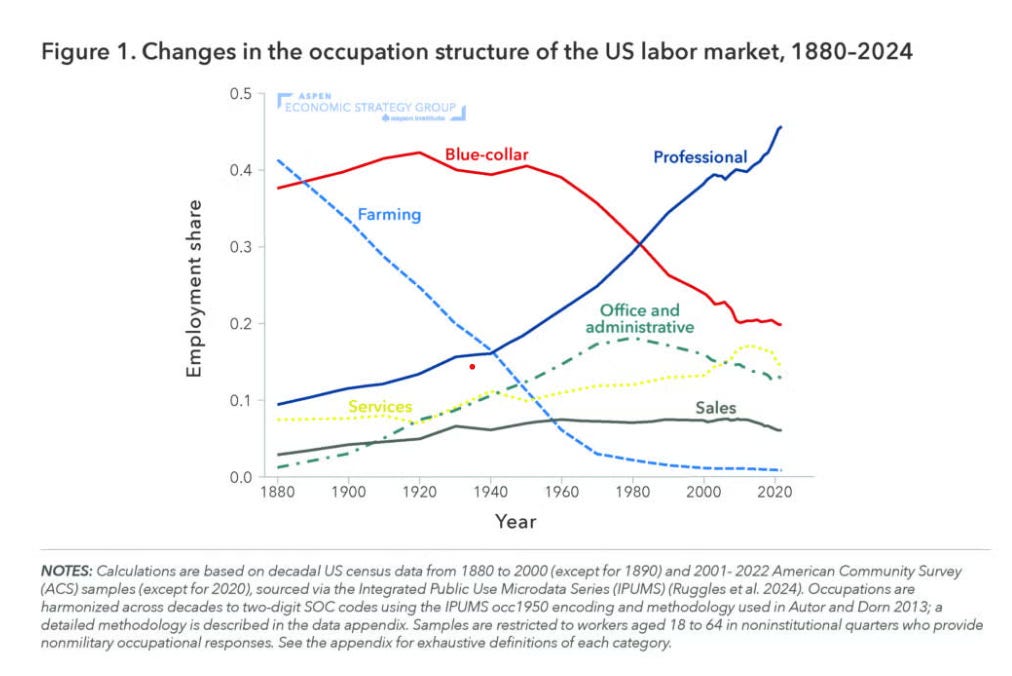
Molly Kinder: Yes, it’s my favorite visual. I would use it in every Substack if I could, and credit to the Aspen Institute for publishing it. It’s not my figure. It’s this remarkable chart that looks at the last, say, 150 years. And what it’s illustrating is where did most people work at the time in the labor market? So what kinds of jobs occupied most people and how did that change over time? So if you go back all the way to the beginning, a remarkable percent of the American labor force worked in agriculture. Agriculture was mechanized and you see the crash. So that’s showing fewer and fewer people as a percent of the labor force worked in it. Then you see this rise of blue collar work. So think manufacturing. It was upwards 30 to 40% or more of the entire labor force. Around 1980, we started seeing this really decline during de-industrialization.
And at the same time, there was a slightly more modest decline in clerical office secretarial work. So you’re watching these ebbs and flows. We had a labor force 150 years ago. Most of us worked in agriculture. That was automated. Then we had lots of blue collar work. Much of that work was automated. Same with a lot of back office and clerical work. So the line that I would really want you to pay attention to is the line in blue, which is this really steep rise of the percent of the American labor force working in professional and managerial roles. Just think white collar work.
The blue collar and the white collar work crisscross around the time I was born, around 1980. That’s the moment where more Americans started to work in this white collar work than in blue collar work, at least as it’s defined here. You see this incredible rise of professional work. And the way I explain that is computers, up until the moment that ChatGPT was launched, we’ve had this 50-year trend where computers provided a tailwind and really boosted high-paid college-educated knowledge work. Really the gains of the technological revolution over the last several decades has really accrued to the knowledge class and this massive increase in the number of jobs. And that has really been the story of our economy until ChatGPT came out. And the big question mark is, are we now entering a different era where those lines are going to bend in different ways?
Tristan Harris: And you basically are speaking to the fact that as the technology was added in this skill-based technological change, they made cognitive workers more productive and expanded demand for their skills, but now AI is changing that. And you argue that the pain of the messy middle is not going to be evenly distributed, that certain groups are going to feel it much more acutely than others. So why is that and which groups are going to be affected?
Molly Kinder: The best way I can describe the impacted this time around is the reverse of COVID. So if you think about the COVID pandemic, those of us who had to go into a workplace during COVID were the ones we were applauding insuring for because they were taking on the risk of the virus on behalf of society. If it required a workplace, so it required a hospital or a nursing home or a food manufacturing plant or a mechanic of some sort, if you had to go into a workplace, you were much more at risk of the virus. We had a whole class of people, frankly the laptop class, who could do their work virtually primarily on a computer that were safe from the virus. And that was really the tenor of the conversation in COVID was more low paid work was required to be in person. It’s manual, it’s dexterous, it’s interpersonal.
I would argue if GenAI technologies, large language models improve to the point that they are substituting for human cognition, they’re smarter than us at many of the cognitive tasks that have been the skill premium that has commanded these knowledge worker salaries. Right now we’re not fully there, but if in the messy middle we get to this point that cognition is commoditized, AI is doing the skilled work that comprise those jobs, I think you’re going to see the exact reverse of the COVID risk. I have a strap line, Tristan, if you can do your job locked in a closet with a computer, eventually you’re probably going to be in trouble. And so it’s the knowledge class in addition to some back office, like a medical coder and a transcriptionist that doesn’t need a college degree. There’s millions of women in jobs like this.
Primarily, it’s knowledge work that could potentially be substituted. And my provocation in this essay is imagine a world where that blue line bends. Is knowledge work the new crash that we’re entering into? Now, I want to give a lot of caveats here, Tristan. We don’t know for sure. There’s a lot of debate. Actually, are some of the smartest knowledge workers going to be superpowered by this? Maybe we’re going to create all sorts of new cognitive jobs. I don’t know the answer to that. I do know for the first time we have a technology in recent decades that actually is potentially threatening the value add of the knowledge class, and that’s an entirely new ballgame. It’s not the low paid workers who are at risk.
Tristan Harris: To pull in a quote from my normal co-host on this podcast, Aza, he’ll say, “If you have a desk job, you won’t have a job.” That’s kind of a similar line here. But you also speak to the erosion. I just want to reference some more lines here from your essay. The erosion of decent paying clerical customer service and back office work. So these are things like bookkeepers, payroll clerks, bank tellers, medical secretaries, admin assistants, call center staff. The mostly women who keep the books, process the claims, answer the phones, and run offices. And then I think one thing that’s important for listeners to get is the scale of this occupational group. Do you want to speak to that?
Molly Kinder: Yes, this is actually a very big passion of mine. In a separate Substack that I hope readers will read called the Invisible Disruption. I frame there are upwards of 15 million to 18 million people in this country, primarily women who have these back office customer service clerical roles. I call the disruption invisible because we never center them in our national conversation. In fact, in most metro areas in this country, the largest occupational group are office and administrative support workers. I’m co-chairing Kathy Hochul’s commission in New York State on the future of work. So I was looking at New York State. All the smaller metro areas in New York State, you’re talking 13 to 15% of the entire labor force is employed in these sectors. The most important thing I would want to convey to your listeners is jobs like bookkeepers, HR assistants, legal secretaries, medical coders, these are the best paying, most dignified jobs for women without a degree.
They pay sometimes as much as median income. They’re gentle on the body so you can retire into them. Nine to five hours, not these service sector grocery retail jobs where you don’t know your schedule till the week before. Amazon warehouse jobs hard on the body. They’re upwardly mobile without going back to school. And I’ve interviewed so many women in these jobs. They’re a foothold into the middle class for women without a degree, and they’re, as a category, incredibly vulnerable to GenAI, in part because you really don’t need a human in the loop for a lot of that work. Now, a smart reader might say, “Well, haven’t these kinds of jobs been going away for some time?” The answer is yes, but AI will light this on fire. And we in this country do not have a plan for these women. We’ve spent the last two decades focusing on making sure the heartland where we lost manufacturing jobs and de-industrialization, we’ve done all this investment in clean energy and infrastructure jobs.
And this is a really neglected population that is quite vulnerable. And just to put a fine point on it, I was recently talking to the CEO of one of the largest tech companies in America, and he told me that they anticipate within two to three years, 60 to 70% of their back office will be gone.
Tristan Harris: Right. Yeah, you have a great line here, which is that AI could do to high school educated women what de-industrialization did to high school educated men.
Molly Kinder: Correct.
Tristan Harris: So industrialization, factory workers, that was the doorway into the middle class as a high school educated man, and then that shifted with the industrialization. And you’re saying essentially there’s a similar shift now that could affect women. And you actually say in your essay, there are twice as many secretaries and admin assistants, 3.2 million, as there are software engineers, 1.7 million. Twice as many bookkeepers, 1.5 million, as there are lawyers, 700,000, and nearly as many customer service reps, 2.7 million, as there are truck drivers, 3 million. So we often talk about AI automating trucking, but just imagine there’s a similar sized occupational group here of customer service reps.
Molly Kinder: And that’s not limited only to the back office work. I think as a society, we’re very programmed to thinking about job loss like a mass event, a factory shutting, hitting an entire community, or a big layoff from Meta. I think it’s important to keep in mind that we’re going to be seeing more disruption that’s quieter. It’s perhaps not hiring. It’s shedding workers quietly. And I really want to make sure that we actually have a plan so this is not families suddenly slip into much more precarious existence.
As a society, we’re very programmed to thinking about job loss like a mass event, a factory shutting, hitting an entire community, or a big layoff from Meta. I think it’s important to keep in mind that we’re going to be seeing more disruption that’s quieter. It’s perhaps not hiring. It’s shedding workers quietly. And I really want to make sure that we actually have a plan so this is not families suddenly slip into much more precarious existence. — Molly Kinder
Tristan Harris: So we’ve mostly been talking about mid-career workers, but I want to ask about the people who are just starting out. And there’s a whole generation of people that did everything that we’ve told them to do. Go to college, study something practical, take on debt, and now they’re graduating into this world. And what does the messy middle look like for them?
Molly Kinder: Tristan, this is a question that has kept me up at night for two years. I think young people coming out of college who did everything they were told to do, who thought the surest way for me to make sure I grow up and achieve the American dream of buying that house, which is now median home price in America is over $400,000. Your likelihood of affording a house when you want to have kids is so much higher if you have a knowledge job that’s close to six figures than it is if you have a job that’s 40 to $50,000 a year. When I interview college students and young people, why are they in college? Why are they choosing their major? What is the American dream to them? Almost every time I hear economic security.
As a generation, they’re so concerned about whether they can replicate their parents’ success. They think they have to get on that professional, that blue line. The blue line is their way to just basic economic security. What worries me about the messy middle for these young people is even before the mid-career and the senior talent might start feeling the pinch, it’s most likely it’s going to be young people first. Many of us who start our white collar jobs, the kind of tasks that we cut our teeth in are the first things Claude is going to take on. To me, this is the fundamental labor market challenge we should be solving today. It’s something I have a bunch of ideas that I’m going to be working on, some pilots and some big ideas to figure out. How do we make sure young people can get experience when employers might have no incentive to pay them to get it?
Tristan Harris: That’s right.
Molly Kinder: It’s a really hard conundrum. And my biggest worry is you have this generation that, frankly, Tristan, this is the generation that was on the losing end of everything you’ve been talking about for so long. Social media got them. During COVID, they were at home. Now they’ve done everything they were supposed to do. Maybe they went to computer science, which everyone said was going to be the growing occupation, or they worked incredibly hard, took out loans. They’re in college, I’ve interviewed so many of these young people, and they see this dream just slipping away. I think they feel this is rigged against them, that AI, they are the collateral damage. I think this should be the number one thing out of the gate that we should be coming up with new ideas because unfortunately our current training system was never meant for someone who just trained, who just came out of college with skills they thought were in demand.
Tristan Harris: Right. We’re not retraining someone-
Molly Kinder: No.
Tristan Harris: We’re not retraining someone who just spent six years and $200,000 in student debt. They actually have to retrain right now. It’s like, how’s that going to work?
Molly Kinder: How is that going to work? Or great, we have these technician jobs and data centers. Is this really a match for someone who was trying to get on a marketing track or an engineering track? So I think it’s a really profound challenge. In fact, it’s not just young people who are feeling it. I think it’s parents who are suddenly waking up to realize, “What is this future for my student, my child who’s just done everything right?” I think I’ve seen this even in economists and experts changing their views on AI when they have kids who are nearing college and they realize, what is this future?
Tristan Harris: That’s interesting. The whole overall point is that it’s not this black and white all or nothing job apocalypse or everyone’s just going to keep getting jobs and finding new things to do. Imagine that people who used to work in the farm had taken on $200,000 in debt to work on that farm, and then suddenly that job goes away and they have to learn something else. It’s just a different equation than the 50 years we had to migrate from farming to something else. And then the other things that people could move to, the trades like plumbers, technicians, electricians, can’t absorb everyone without the wages for those trades collapsing from oversupply. Do you want to speak to that too?
Molly Kinder: Yes. I think it’s important to realize that in America, we have a student debt crisis. When you look at countries like Germany, students can go to university for essentially free. In America, we ask 17 and 18-year-olds to make an incredible financial investment and bet on their future and in their course of study. I think that’s a lot of the anxiety of these young people. The paralysis that I talk to with young people, how do I even choose a major? Do I go to law school? Is this worth taking out this much debt? The debt I think is a massive factor into how individuals are going to experience this messy middle. I think that is adding so much to the angst and the sense of scarcity, not abundance. I named in the Substack that this trite, “Oh, everyone should be a plumber and an electrician,” is one of the laziest moves in the discourse. It really offends me.
Tristan Harris: And it’s something that people in AI say all the time.
Molly Kinder: All the time.
Tristan Harris: Like, “Oh, people will just find something else to do. It’s not that hard to become an electrician or a plumber. We’re just going to have more of those.”
Molly Kinder: Yes. And there’s almost a snide come up in language with certain folks of, “Well, this is the time for the educated class to go get a real job. These are all bullshit jobs. You should go get a real job, work with your hands.” I am very enamored with the idea of more young people who find fulfillment in the skilled trades going into the skilled trades. They are truly excellent jobs for people who want them. And they provide without a college degree, but with the same amount of time it takes to go to college. It takes four years of really rigorous training to become a professional in the skilled trades. It’s a wonderful career path for a lot of people. We should de-stigmatize it and make sure more young people would find it attractive. It is not a mass market labor sponge for everyone who thought they were going to be an accountant, a market research analyst, and a finance analyst.
If you just look at the numbers, I was just yesterday looking up how many accountants we have in our economy, software engineers, project managers, really prototypical white collar jobs compared to just the sheer number of electricians and plumbers, and they don’t even remotely match up. If everyone suddenly shifted and said, “Well, the safe ground are these 80, $90,000 a year unionized skilled trade jobs, which genuinely are excellent jobs,” two things could happen. One, they’ve become incredibly competitive because there’s a dearth of trainers. It takes four years to train. You’re not going to overnight turn everyone into a plumber. And if suddenly you lower the barrier to entry and you flood a lot of people into those jobs, you lose the scarcity and the wage premium. And we can’t act like everyone can simply move into this. The numbers don’t work, let alone the fact that there are preferences that some people might not want to be a plumber.
They might be a creative. They might love writing papers. They might be someone who’s a math person. I mean, we all have to express our individuality and we shouldn’t assume everyone wants the same job.
Tristan Harris: What I love about your analysis is it’s just a system’s analysis. You’re seeing the feedback loop. Oh, well then this offered. And then people usually stop the analysis there. Everyone will become a plumber. And you’re saying, “Yeah, but look what happens in the feedback loop as those wages then shift.” It’s just so precise and it’s really good. When we had you on the podcast last year, you also shared analysis that you did with the Yale Budget Lab that showed that AI was having very little impact on the occupational mix of the economy. Are you seeing anything that makes you rethink that conclusion?
Molly Kinder: The Yale Budget Lab analysis continues. They have found very similar story. At a very macro level, we are not seeing economy-wide labor disturbance, the kind that you would see really across the board. I think the best evidence that there is at least something happening is coming from Stanford with some of the early career. We are seeing evidence, for instance, of a decline in some clerical roles that’s likely tied to AI. But overall, we are still not seeing a very large meaningful disruption to labor force. I would call us still in reality one. My prediction, and this is just a prediction, is that this is a story that will change, and it won’t take a very long time to start seeing more of the displacement that we’ve been anticipating. I would say in the next two to three years, I would expect to see a much greater disturbance than what we’ve seen today.
Tristan Harris: To capture this in a meme is, and I used an AI generator to make a New Yorker cartoon, that had two horses in a carriage saying, “There’s more horses hired today than ever before,” right next to a Model T sitting next to it.
Molly Kinder: That is brilliant. Yes, I love it. It’s one of those things where it isn’t painful till it is.
This is the generation that was on the losing end of everything you’ve been talking about for so long. Social media got them. During COVID, they were at home. Now they’ve done everything they were supposed to do. Maybe they went to computer science, which everyone said was going to be the growing occupation, or they worked incredibly hard, took out loans…and they see this dream just slipping away. I think they feel this is rigged against them, that AI, they are the collateral damage. — Molly Kinder
Tristan Harris: So now, one reason I really resonated with your piece is that you have a healthy skepticism of both the timelines of the kind of AGI believers and of the economists and techno optimists who say there’s nothing to worry about here. We’re not seeing the data. The job apocalypse hasn’t happened. Could you walk me through your response to these different camps?
Molly Kinder: Sure. I’ll start with the Silicon Valley crowd. So in fact, the impetus for this post was a conversation with Dwarkesh who has a really renowned AI podcast reacting to what I hear from the AI crowd who tell me, “Molly, there’s no point in all this work you’re doing to come up with interventions, say to help young people who are displaced from the early career, because we’re going tomorrow to nobody has a job. There’s no point in doing any policies.”
Tristan Harris: It’s a fool’s errand.
Molly Kinder: It’s a fool’s errand.
Tristan Harris: Anything you’re doing right now is just going to be expired in three, four years when we have AGI.
Molly Kinder: It’s going to be expired. There’s literally no point. And the other thing is don’t worry because everyone’s simply going to get a check. That’s the answer to everything. So that’s really what I was rebutting against in this piece. Now, the reason why I don’t agree that tomorrow we’re going to no jobs is lots of reasons. One is that it’s actually very hard to automate with existing technologies at least 50 to 60% of the entire labor force that has jobs that are very manual, in-person, interpersonal, unstructured. There’s a lot of jobs with pretty mild exposure, everything in teaching and healthcare and repair and service sector jobs, a masseuse, a waitress. I mean, scores of jobs in this economy cannot be done by Claude or ChatGPT. And we’re many years off from having an economically viable robot that’s able to go in all those workplaces and do that job.
I think we’re many, many years off from that. We are not looking tomorrow to see a world where there are zero jobs. That should not give us too much comfort though, because actually I think a messy middle when only some jobs are lost is a very difficult one to deal with.
Tristan Harris: Yeah. I mean, look how difficult it was to deal with the first de-industrialization and globalization wave.
Molly Kinder: And I mean, no one looks back at that period and think we got it right. And if it’s a general purpose technology and we start commoditizing cognition, maybe it’s going to be hard to move from a market research analyst to jobs that are similar, that use similar tools if this is a general purpose technology. So I think this is potentially painful in pockets and not something that we’re going to see overnight. Now, I think the number of economists who won’t entertain the possibility of my version of the messy middle where you don’t see a full job’s apocalypse, but you are seeing concentrated pain is growing to be almost to the point of being mainstream. So I think we’re really seeing a shift in the tone.
I think part of the challenge is our discourse is so polarized that because there’s such an extreme version, all jobs are going away tomorrow, it forces sometimes people to overreact to say there’s nothing to see here. When in reality, I think we’re really talking about something in the middle.
Tristan Harris: I just want to quote David Friedberg from the All-In podcast from just June 2026. That’s just a month ago from when we’re recording this podcast. And he said, “There is no job loss with AI. I’ll say it again. I’ve said it a thousand times, and I’ll say it again and again and again. The idea that AI is going to destroy jobs is a Luddite idea that is being disproven every single day. I see it on the ground. It is only a matter of time before people wake up to this and realize that this narrative that they’ve been sold is a crock of bleep.” And I say this because these are actually very influential folks. The All-In Podcast is one of the most popular podcasts. It’s very close to the administration’s policy, very influential to the administration. And I agree with you that more people are coming alongside to this perspective.
I think your piece in this podcast is one of the things that I’m hoping will move people. Now I just want to keep going here. So in the debate between economists and technologists or the AI crowd, the economists will often say to the AI folks, “Now you don’t know enough about the laws of economics.” And then the technologists or AI folks will say, “Well, you’re naive about the technology. You’re actually fighting the last war. You don’t really understand that AGI is a paradigmatic change.” And now you are an economist who really stays up at night on the tech frontier here. Do you agree that our old economic models are really not up to the test to handle this disruption from AI?
Molly Kinder: I don’t know that I would say that our old economic models, I think maybe some of the precedents from history from economics seem more reassuring. I think there’s a sense of economists look to the past and say, look, look at the figure we talked about with the lines going down and then lines going up. There’s always going to be lines going up.
Tristan Harris: And it has happened so many times throughout history that we were afraid and then we actually always found something else to do. And so that does provide a grounded reason for reassurance. But then it comes back to, is this fundamentally a different kind of thing or not? Go on.
Molly Kinder: Yeah. And I would say there are still, I think there’s a difference between a conversation about net jobs. Are we going to a world of prolonged net decline in jobs versus a very painful disruption to certain very good jobs? And the jobs that grow don’t have to be as good as the jobs that went away. So if you think about a first Industrial Revolution, it took a hundred years, Tristan, for the living standards to catch up to what they were at the start of the industrial revolution. So that is not a positive story. Are we willing to wait 100 years for living standards? Is this a trade-off we want to make for what? My great-great-great-grandchildren? And then I think if you look at de-industrialization, we created five times as many jobs in the period that we were losing manufacturing jobs as that went away.
Just creating jobs does not necessarily mean that the people on the losing end can connect to another job that’s the preference, the pay, and the place of the one that they lost. This is not a prediction. I don’t know. I don’t have a crystal ball. We could easily find ourselves in the world that some of the most coveted jobs in this economy are displaced and the jobs that rise pay a lot less and are not as dignified or fulfilling. So you might still have employment, but is it going to be the employment that gives us dignity? Are we going to be basically the overlords of a bunch of AI? There’s a lot of ways you can imagine net jobs or net productivity going up just like it did during de-industrialization, and maybe us not feeling that what’s coming up online matches what we lost.
Tristan Harris: This is a great place to double click because you very succinctly articulated in your piece comparing it to the de-industrialization baseline. So why could the knowledge class version of what happened in de-industrialization be worse?
Molly Kinder: Yeah, so I think we all know how de-industrialization turned out. Entire communities were abandoned and left behind. We see deaths of despair, we see rise of alcoholism and suicides and men coming out of the labor force. It was an abject disaster, but it was contained to a certain part of the country and a certain type of work. And there it was an economic and social disaster that turned into a huge political backlash. I think what we could be facing in the messy middle, if AI advances to the point where it just means you start losing some of these high paid, high status, coveted jobs, I think this is going to have a much greater political shock than we saw in de-industrialization. It will be immediate, it will be felt, it will not be ignored the way these communities felt ignored for so long. It’s going to be in the face of the political establishment.
These are people with status and access and a voice, and there’s a lot to potentially lose. And so I think if I’m right that these knowledge sector jobs that are on the exposed end go first well before we get robotics to a point that you might be able to displace jobs that are sort of lower down the pay scale, we are going to have a political crisis because are you really asking people like the ones who had to show up during COVID to lower paid jobs in the workplace to foot the bill for paying the salaries of displaced knowledge workers say in perpetuity? There are also fiscal implications. Upper middle-class workers are really disproportionately represented in the income tax and property tax revenue, and they’re the customer base. So they’re really-
Tristan Harris: Yeah. They’re the ones who make a lot of the economy. They’re paying restaurants, they’re going out, they’re doing travel.
Molly Kinder: Exactly.
Tristan Harris: And so suddenly when that base disappears, again, your analysis is this sort of systemic and cascade kind of view of here’s how these things grow. It’s not, as you said, the net jobs are not. It’s the what kinds of jobs are getting affected and what role did they have in the economy and what second order effects occur from them getting disrupted?
Molly Kinder: Exactly.
Tristan Harris: Now I want to just head off the take here that what we’re saying might be seen as classist. We didn’t worry last time because it was just hitting factory workers, but now we’re worried this time is affecting our class. And the point is, no, no, no, this is about caring for people in the broadest sense, but recognizing that the same kind of story that we were told in the China shock, which was, “Hey, we’re going to outsource these jobs, these manufacturing to China in globalization, and we’re going to get this world of abundance and cheap goods.” But then that actually did affect the fundamental social fabric and the kind of dignity and law and all the things that you’ve just talked about. And there’s another kind of parallel thing here of an AI shock. It’s just going to be bigger than the China shock, but we’re offered a similar bill of goods.
It’s going to be cheap, abundant goods. We’re going to have, as Elon Musk said, not just universal basic income, but universal high income. And at the same time, which first of all, I don’t think is actually true, we’re also going to get this mass disruption. I just want to head off the idea that we’re only concerned now because it’s hitting white collar. It’s like, no, no, no, we’re concerned in general about making sure this was a transition that’s going to work for everybody.
Molly Kinder: I think it’s a very important point. I worry that some of our discourse is starting to divide us, that I’m seeing conservative backlash saying it’s women or it’s knowledge workers or it’s lesbians with a philosophy degree trying to divide us in some way. I think that is really missing the point. We already have a country in an economic security crisis. We should be strengthening systems that catch all of us. We should be thinking about creating good jobs for all of us. So it should be something that unites us as opposed to divides us.
If AI advances to the point where it just means you start losing some of these high paid, high status, coveted jobs, I think this is going to have a much greater political shock than we saw in de-industrialization. It will be immediate, it will be felt, it will not be ignored the way these communities felt ignored for so long. It’s going to be in the face of the political establishment. — Molly Kinder
Tristan Harris: Absolutely. So I want to get to solutions and first start with the solutions that people are talking about and proposing, especially in the AI community. So one is we’re just going to have redistribution. Well, yes, all this wealth’s going to accumulate to a handful of AI companies, but then we’ll just tax the AI companies and we’ll send everybody a check. Is this going to happen? Is this good? Is this true?
Molly Kinder: One of the motivations for writing this messy middle was to disabuse this idea that, oh, tomorrow there’s going to be these gains. Don’t worry about software engineers and bookkeepers losing their job. Everyone in society is going to get this really big fat check. And that means it doesn’t matter if you’ve lost your job because you’ll just get this income replacement.
And I wanted to bring in the political economy to say in a messy middle situation where only some people are losing their jobs, and my argument is some of those people are going to be making higher than median wage, potentially much higher than median wage. If you write a check big enough to cover the salary that was lost by a software engineer for everyone in society at a time where COVID just proved essential work is literally essential for the economy and society functioning. If everyone in society got a $200,000 check, do we really believe we have a functioning labor market?
Tristan Harris: Yeah, that just completely changes the rest of the job market in a way that doesn’t really work.
Molly Kinder: It doesn’t really work. You lose the incentive to have a labor market in the first place. And okay, you could argue to say, “Look, you’re going to have to pay those people on top of their 200,000, some huge check to go to work, but where is this money coming from?” There’s that labor distortion that I wanted to point out. But second, there is the true political economy challenge of how are we going to make sure we capture enough of these gains in an environment where if you look at our last major legislative package, we’re cutting taxes for the rich incorporations. We’re cutting back food stamps and Medicare for the neediest populations. We live in a country where the idea that you’re paid not to work is anathema to the vast majority of Americans. And we have a tax regime where we are not really taxing our wealthy and there’s a real aversion to it. So I think this notion that-
Tristan Harris: It’s important that there’s attempts to tax some of the wealthy, but there’s currently a lot of efforts to fight it. And there’s a line here, “Watch what they do, not what they say.” Sergey Brin, the co-founder of Google, moved to Nevada and poured tens of millions of dollars into fighting California’s proposed billionaire tax. And that’s still while AI displacement is a forecast.
Molly Kinder: Right. And to be fair to the billionaires fighting those taxes, it is a very poorly conceived bill.
Tristan Harris: Correct.
Molly Kinder: There is a much better version. So I don’t want to criticize them for doing that. My point is the public is eyes wide open. They watch the behavior, not the rhetoric. And to be told, don’t worry about this potentially very painful period ahead because what’s coming is this universal high basic income. I think the public has a lot of skepticism.
Tristan Harris: I want to slow this down for a second. I think there’s a lot of subtle elements here. So just first to steelman the case for the billionaires, it’s not that they actually don’t think there should be a tax. They just want to make sure that money would be very, very well spent. That might be their position that giving it to the current government apparatus is just like throwing it in a wood chipper and it just disappears. But what I wanted to say was that there’s a frame we often invoke in our work by the author Luke Drago and Rudolf Lane of The Intelligence Curse that basically as more economic GDP comes from AI and data centers and not from people. So you’re getting a return for total country GDP from AI data centers and not as much from the labor of individual people. Now you’ve got some government revenue coming in.
Do you have any incentive to invest in the development, education, childcare, healthcare of your people? And the answer is no, not really. And this mirrors a phenomenon in economics called the resource curse where if you have a country like Venezuela or South Sudan where the country’s GDP comes from say oil, you have an incentive to invest in oil infrastructure and not in your people because you don’t get a return from that. What happens now when we don’t get a return from that skill premium class because we don’t need them for that anymore? There’s some just more embedded and layered risks here.
Molly Kinder: Yeah, absolutely. I think that’s a really astute point. And I think there’s just generally a massive, very daunting existential challenge, which is if we are going to move beyond the messy metal into this reality three, into a world where truly AI is capable of all the valuable economic activity and the wealth is shared in some way, hopefully, how does democracy survive? What does the state need of us? I’ve got three young kids. I mean, I imagine their future in a world of a check and a hobby. And I wonder what’s their purpose? What gets them up in the morning? What do they strive toward? How do they feel they’re needed and they matter? I mean, there’s all these issues, let alone these questions of as a society, how do we function? How does the democracy hold? So lots and lots of complexity there. And I don’t mean to dismiss that it’s essential to any future we move into, that we’re able to raise resources and capture appropriate this wealth, share this wealth.
I just think some of this soothing message from Silicon Valley that don’t worry, just trust us through the messy middle because we promise there’s a new Garden of Eden on the other side and it’s a utopia. If it requires a distribution and a willingness to pay tax that we have yet to see evidence of, I think that’s a really scary premise for the country.
Tristan Harris: 100%. And in the Intelligence Curse essay, Luke and his partner, Rudolf, talk about solutions to the intelligence curse, which is that countries like Norway that did discover a massive resource of oil, but then turned it into a sovereign wealth fund, and then they locked in political power and public oversight for citizens to make sure that the gains were democratically distributed. But you need to make sure that you create that democratic lock-in, that democratic oversight and control and distribution early while the people still have political power.
Molly Kinder: I agree.
Tristan Harris: People should be thinking about this going into the midterm elections. They should think about this going into the presidential elections in a couple years. So let’s go into another solution that’s commonly thrown around by Silicon Valley. We’ll just retrain people. We’ve talked about this a little bit, but let’s actually look at the historical analogy for how we did this during the Clinton NAFTA era promise of a re-employment system. How did we do? Does retraining work? Could it work this time?
Molly Kinder: I think our most recent example of a major economic disruption where retraining was meant to be the answer, that was the social compact, it went terribly. So in the Substack I recently put out about why we can’t retrain our way out of this, I went back to some archival footage and I got a video of Bill Clinton 30 years ago signing with three other bipartisan presidents some legislation around NAFTA. So just as we were creating these trade agreements. And at the time, there was a huge amount of concern about job loss. The unions were really worried about it. There was a fear the jobs were going to go overseas to Mexico. And the response was, “Well, we’re going to gain overall from trade,” which we did. And the way we’re going to deal with the losses, which sounds just like today, Tristan, is we promised to re-employ you to retrain you.
So Bill Clinton made this big promise, and the main policy that was meant to deliver on this was TAA, Trade Adjustment Assistance. And we did not retrain our way out of de-industrialization and the loss of those jobs. Very few people moved despite some of these incentives. Very few men moved into higher paying jobs. Most either left the labor force or fell into worse paying work. There were a huge boom in healthcare jobs and professional and managerial jobs that either required more education or were not the identity or place or preference of the people who lost jobs. If that was supposed to be the social compact that was supposed to catch these many millions of people as they fell from China joining the WTO or NAFTA, it didn’t work. And we can see that in the results. And now I see us entering this new era where I honestly, I walk into rooms.
I made a fairly passionate speech at an event I was at this past week where I listened to an entire panel talking about retraining. And I got up and said, “This sounds like 30 years ago Bill Clinton talking about NAFTA. You’re talking about the skilled trades and apprenticeships, and I hope these women are going to find their place now in plumbing and young people just need AI skills.” I though, oh my gosh, I am going back in time and we’re saying the exact same thing, which is not to say we don’t need to invest in training. Plenty of people are going to need to find some new skills or adapt. I’m really excited about a bunch of big efforts to improve our training system. I would caution us to think retraining is the main answer that we should hang our hat on. I think the danger is if we repeat the NAFTA, Bill Clinton, our promise to you is we’re going to retrain our way out of it.
There’s just the track record on retraining does not allow us to have confidence that we can do that this time.
Tristan Harris: Okay. We sort of outlined many of the false solutions here. I want to get to, if these aren’t the answers, then what are the answers? What everyone’s been waiting for. What actually can we do?
Molly Kinder: So I think when I think about this set of solutions, recognizing that if we let the technology rip and hope we’re just going to catch people when they fall like a broken egg and put them back together and move them to some better job, if you take that as a given that yes, we should try on retraining, but we’re probably not going to be able to make this just go away for most people. I think it leads to this more preemptive question of what’s the right pace of disruption in the first place? Does everyone really need to lose their job? And that’s sort of an obvious question, and yet it’s not coming up in the conversations that I’m part of. I think when we rush right to our traditional workforce development solutions, it already assumes the disruption. And I think we should be having really robust conversations about how do we actually actively manage this?
Not just let the market do whatever it wants and let the technology rip, but how do we manage the pace of disruption in a thoughtful way? And I think a lot of people will say, “Oh, no, Molly, we have to beat China. The whole point of this is we have to be accelerationists.” And I think the irony in all of this is China is doing a better job of managing the pace of job loss in their own country than we are. And we’re supposed to be doing this to beat China. China’s entire political compact is predicated on economic opportunity. They cannot just have mass unemployment. They’re being much more thoughtful about it. And so I look at our own country and say, “”Wait a minute, if China seems to be more thoughtful, why are we not having a conversation that, again, does not try to lose a geopolitical edge?”
It doesn’t say we’re anti-technology. It says, “What happens if we actually try to be in the lead on this and ask some harder questions about expectations?” And I think we should be having a conversation about what are the smart policies that would allow us to meaningfully manage the pace of disruption? And that could be a set of carrots and sticks. You can incentivize employers, you could make some frictions. Maybe you need some advanced warning, maybe you have some mild regulation to just make it a little bit more costly to have to let someone go. I think there’s lots of things we can be doing on tax. Right now, we favor capital over people. There’s lots of things we can do there. That’s a no-brainer. The most bold statement, which I’ve heard from some of the most powerful tech leaders is a token tax. Just make AI more expensive and slow the whole thing down and maybe make some exceptions for the sectors we want.
I don’t know how much political appetite there is for that, but we can think about other ways. So I think one, I think that the American public I think would feel better if they felt their leaders were managing this proactively and not just letting us go. So that’s the first bucket. I think the second bucket is we do have to do a better job of managing the collateral damage of this, the pain that comes associated with losing your job. We are long overdue. This is a no regrets bet to fix our unemployment system. It is terrible. Not only are the policies lacking in generosity compared to especially other European countries, but the systems themselves are creaking and breaking. They’re not user-friendly. I would shudder at the idea of being unemployed, fearful of keeping food on the table with my kids and dealing with their unemployment system.
There’s a lot of good ideas on the table, Tristan, about what if you’re older in your career? Retraining is probably going to be not in the cards. You take the examples in my Substack of the gentleman who’s in his 60s. What about a wage insurance? Over a certain age, can we just accept you’re probably not going to retrain? Wage insurance basically means if you had this salary here, you lose your job and you can only go down here. There’s a insurance that sort of helps make up some of that difference. We have some big questions about for how long and who’s eligible, but I think these are some of the ideas. We have to do something on healthcare. We have to think about people who had employer-provided healthcare and lose that. I think the third category that I’m excited about that I’m not hearing enough energy on is if we are going to see a big productivity burst that’s going to result in people losing their jobs, we do have ways to capture some of that surplus.
Why don’t we talk about the big moonshot bets of the jobs we want to create? There are lots of ways the government can either incentivize the private sector to create more jobs, or we can actually pick some problems we want to solve as a society and create some really good jobs. I would love to see the next president come in and say, “Look, in my first 100 days, I want a moonshot bet of a big, bold, high quality jobs agenda where we are making sure there are jobs in the future. It could be entrepreneurship, it could be in the social sectors, whatever it is, we can define that.” And so I think we should be talking more about what are the big bets we can make to actually grow the kind of opportunity that I think people want.
And the last thing is, I know we talked about early career. I think this is something we need really bold new ideas around. And I think we need to rethink higher ed. I think we should make sure that when you’re going to college, you’re not just walking away with four years in a classroom. Your tuition dollars got you really good work experience that makes you more valuable than Claude in the workplace. Really rethink what comes with college. I think the most interesting thing right now is how do we rethink how employers train it all? When I think about a law firm, you’re not going to need doc review anymore, but someone coming out of law school is not ready to go present in court. Can we take the medical residency concept where medical residents are not doing tasks? And what if you took pro bono law and repurposed that to the training ground? What if in a consulting firm you picked clients that normally couldn’t afford your service and that’s your residency?
How can we dramatically rethink how a young person comes in to become more senior? And then how can government make it so that companies are willing to pay for it? Because they’re not going to be willing to pay. There’s probably some sector levy, I call it a worker reinvestment fund where it’s use it or lose it and you can use it to incentivize training. But I think we need to be thinking really differently about opportunity for young people.
If we let the technology rip and hope we’re just going to catch people when they fall like a broken egg and put them back together and move them to some better job…we’re probably not going to be able to make this just go away for most people. I think it leads to this more preemptive question of what’s the right pace of disruption in the first place? Does everyone really need to lose their job? And that’s sort of an obvious question, and yet it’s not coming up in the conversations that I’m part of. — Molly Kinder
Tristan Harris: I love that last one because it’s something we only barely touched on, which is the idea that if law firms can now basically just get rid of the base of all the paralegals, the early stage lawyers, because that’s the stuff that Claude can do, and then they just harvest all the gains at the top and they all get super productive at the top, but then they have no incentive to ever hire senior lawyers. So how does anyone become wise enough to do that intergenerational wisdom transmission for all these different fields?
Molly Kinder: Yes.
Tristan Harris: Whether it’s law or medicine or things like that. So I love your idea of a residency, apprenticeships. It’s relational. Again, it’s humanistic.
Molly Kinder: Relational. Yes.
Tristan Harris: It’s that that is the thing we’re trying to preserve. We can’t outsource fundamental wisdom or life support system knowledge that our society depends on.
Molly Kinder: Yeah, I think you’re exactly right. I think if we don’t do this, we could achieve geopolitical goals or climb some incredible economic summit at the expense of every human in this country.
Tristan Harris: Which is what we did in the China shock before.
Molly Kinder: Yes.
Tristan Harris: It’s just a version of that that’s now more totalizing.
Molly Kinder: Exactly. And when I think about the way the American people that I talk to feel, there’s a lot of anxiety. There’s a lot of fear. A lot of adults are walking around worrying like this is Russian roulette. Am I going to wake up one day and some new version of ChatGPT is smart enough to do my job? There’s a real existential fear out there. And I think what really makes it worse is it doesn’t feel there’s a leadership in charge that’s putting humans first.
And so I think really what needs to happen is a plan, a sense of, yes, we have all these other goals. We need the summit. We need the geopolitical win, but we have to keep humanity at the center of this. And even if you’re not a humanity person, the ripple effects, the political backlash. I mean, there really will be no AI future if everyone burns everything down.
They’re going to lose their social license to operate. So my hope is that what’s going to come out is a real sense of putting some of these human needs first and not just catching people when they fall, but asking these questions, what should an AI economy look like that puts workers at the center?
Tristan Harris: Molly, thank you so much for coming on Your Undivided Attention. This has been a really fantastic conversation. I hope people share this far and wide. It’s so important what you’re doing.
Molly Kinder: Thanks, Tristan. I really enjoyed being here. I really appreciate it.
We’re working to empower policymakers, technologists, and everyday people to guide technology toward the public good. If you value our work and want to support it, consider donating.
Originally posted on [ Center for Humane Technology ]


1 thought on “Enough Debate about the AI Jobpocalypse. We Need To Plan for the Messy Middle.”
Yo, this article be hittin’ hard, ya feel me? AI got peeps all twisted ’bout jobs and money. Gotta keep it real, workers need more than just promises. Ain’t no way we can just chill and let tech take over. We need plans, not just talk, ya dig?
Comments are closed.